Arranging For Fingerstyle Guitar
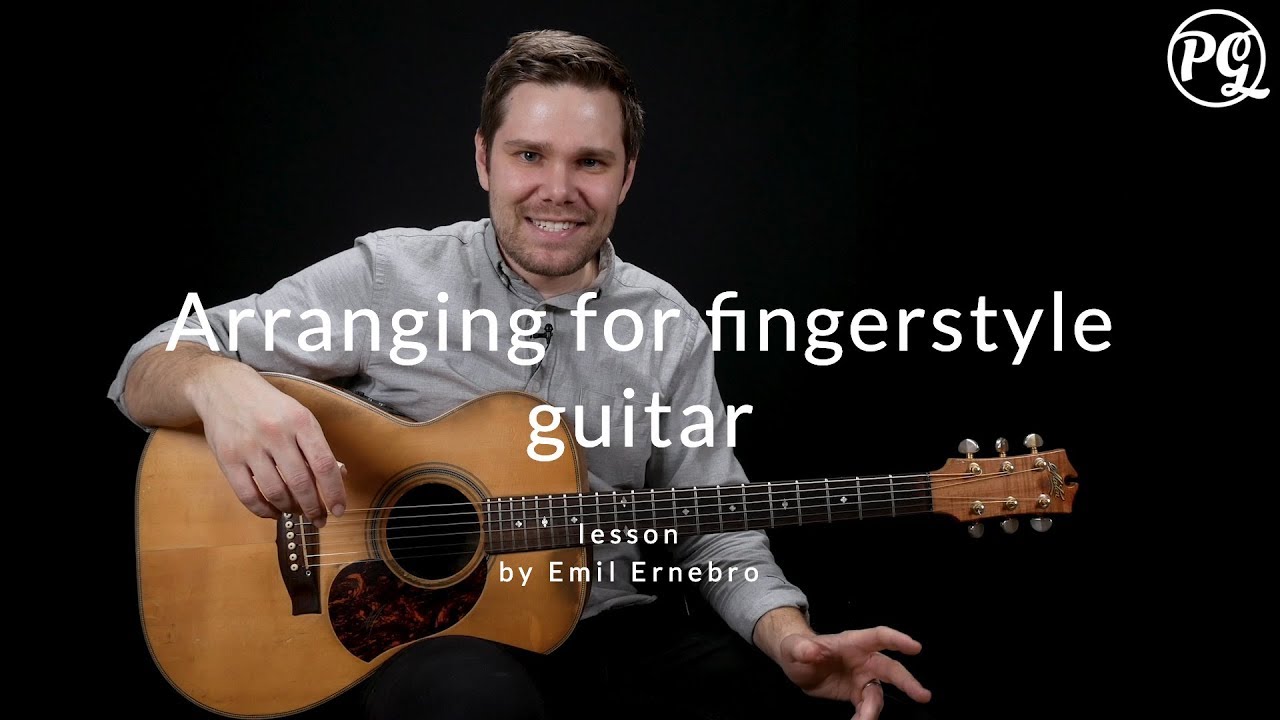
That was the preview
Watch the full lesson with tabs and backing tracks.
About This Lesson
In this in depth lesson called "Arranging for Fingerstyle Guitar", we cover the key elements that you need to learn to be able to arrange for solo guitar. We also learn useful techniques and ideas that will add spice to your arrangements and songs.
Finding the right key
Chord inversions
The "Boom-Chick" alternating bass
Using the open strings
Chord embellishment
Chord substitution
Chord families
Moving bass lines
Using the circle of 5ths
Harp harmonics
Altering the V7 chord
Tritone substitution
Arrangement analysis
More about the lesson:
87 minute video lesson
17 page curriculum with detaild TABs and notation
3 camera angles for a clear view of both hands
Let's learn!
then $19.95/month after 5 days
Unlimited access to all lessons, tabs & backing tracks
$0 today · $19.95/month after 5 days · Cancel anytime
Already have access?
91 students have opened this lesson
Your Instructor

Emil Ernebro
Fingerstyle, Solo Acoustic Guitar & Arranging
Awarded "Outstanding Player" at Musicians Institute (Hollywood), winner of "Young Talents" at Uppsala International Guitar Festival, recipient of the "Guitar Peoples Prize" and "Hagström Guitar Scholarship." With over 200k Instagram followers and 90k YouTube subscribers, Emil performs ~100 concerts/year, records award-winning albums, and teaches fingerstyle guitar through ProGuitar lessons.
View ProfileWhat Guitarists Are Saying
“So awesome of you to give us this beautiful arrangement. Plenty of time to learn it for Xmas. Cheers!”

“Thank you for posting this fabulous tutorial and rendition of this timeless classic. A healing song to hear you play it, but then being given instructions on how to play it, is above and beyond. Thank you. The harp like harmonics are heavenly and adds to setting this version apart from all others. You are a man of endless talent and a man of your word, for doing this. Blessings to you.”




Ready to Level Up?
Get instant access to this lesson and 346+ more with ProGuitar
Already a member?
$0 today · 30-day money-back guarantee · Cancel anytime
Questions & Answers
91 students have opened this lesson
Hi Emil, Really enjoyed the lesson. I have question about tritone substitution. Most of the theory that I've read on this subject says that a dominant 7 chord can be replaced with another dominant 7 chord which is a tritone interval away from the original. However, in the Amazing Grace arrangement, you replace an D7 and and A7 with an Abmaj7(#11) and an Ebmaj7. They sound great but I was just wondering if there is a rule that the new chord substituted for the dominant 7 should also be a dominant 7. In other words, when can the new chord be something other than a dominant 7? Hope that makes sense. Thanks, EB
1 reply
@elzevir-block Hi there! The tritone substitution concept does not always include only dominant 7th chords. The most obvious choice of chords (using tritone substitution) for A7 and D7 would be Eb7 (instead of A7) and Ab7 (instead of D7). However, you can always try other chord qualities as well, such as maj7 chords in this case. The original progression is just G7 going back home to C. I added a D7 (dominant V chord of G7) before the G7, and an A7 (dominant V chord of D) before the D7. Instead of keeping it that way, I then used the tritone sub on the A7 and D7, finding the chords Ebmaj7 and Abmaj7. Original progression: G7 ---> C... New progression: Ebmaj7 ---> Abmaj7 ---> G7 ---> C... Now, you could look at this progression from another angle too; The Ebmaj7, Abmaj7 and G7 chords can be found in the key of C minor. So you might analyze this as borrowed chords from the C minor tonality, rather than C major. Hope this helps! Kind regards/Emil
Ask Emil directly
Members post questions under the video and Emil answers personally.
Start 5-Day Free Trial